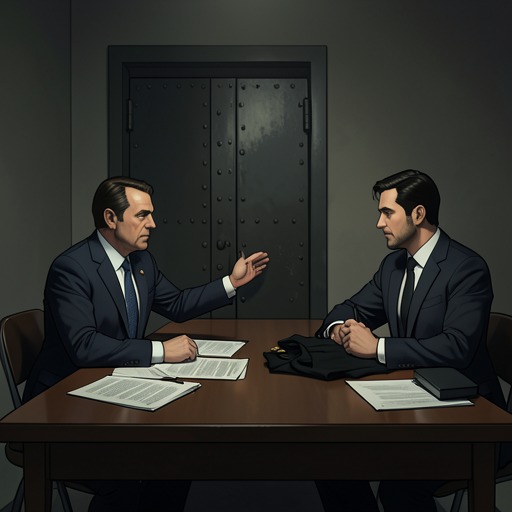
Marvie
Naked LunchMarvie is a former State Department employee and one half of Interzone Imports Unlimited, a pharmaceutical concern whose ambitious cross-border deals repeatedly turn commercial success into farce. In the whale-waste K.Y. venture, he pursues a commission while insisting on the distance and respectability of a senior trader; the resulting disputes expose the fragile paperwork, improvised financing, and transferred risks beneath Interzone’s business talk.
Identity and Background
Marvie has been in Interzone since what he calls “the year before one.” He says that he retired from an unspecified position in the State Department “for the good of the service,” a tactful formula that leaves his actual history unclear. His former appearance is described as that of a handsome, crew-cut college man, but by the time of the narrative his face has sagged and developed lumps beneath the chin, and he has grown heavy around the hips. The contrast between that remembered image and his present condition accompanies his attempt to preserve an air of status amid increasingly precarious trade.
Marvie’s enterprise is Interzone Imports Unlimited, which he runs with Leif the Unlucky. The firm specializes in pharmaceuticals and operates a round-the-clock venereal-disease treatment station as a sideline. Its commercial reach belongs to the wider landscape of adulterated medicines and counterfeit goods: elsewhere, a dealer’s career runs from a sex shop in Yokohama and drug dealing in Beirut to pimping in Panama, then wartime profiteering through diluted dairy products and other dubious merchandise. Marvie’s own venture fits this environment not as an isolated eccentricity but as a piece of a trading system in which dubious goods and dubious intermediaries are routine.
The K.Y. Deal and Its Commercial Logic
Marvie and Leif seize on a shipload of K.Y. made from whale waste. The cargo is quarantined by the Board of Health in Tierra del Fuego, and the material is described as rejected refuse from whale processing, with no established use. The proposed sale turns an unwanted, suspect substance into a prospective fortune: Marvie presents the commission as the prize, while the shipment’s origin and quarantine mark the risks that the sales pitch pushes aside.
The partners plunge into the transaction by arranging favors for a Greek shipping agent and a full shift of customs inspectors. Their operation depends on intermediaries and inducements rather than a straightforward passage through official channels. As the deal develops, the partners fall out and accuse one another of trying to steal the commission. Marvie claims that he has the bill of lading; Leif counters that Marvie will not see it until his share is deposited in escrow. Their disagreement makes the documents themselves instruments of leverage: each partner needs the other’s cooperation, but neither trusts the other to deliver it.
They eventually shake hands without enthusiasm and peck one another on the cheek, only for the transaction to drag on for months. After engaging an Expeditor, Marvie emerges with a check for forty-two Turkestan kurds, drawn on an anonymous South American bank and routed through Amsterdam. Clearing it is expected to take about eleven months. The elaborate route and long wait turn the promised windfall into a paper claim whose value remains uncertain and inaccessible.
Partnership, Status, and the Cost of Success
Marvie treats the check as proof that the deal has succeeded, displaying a photostatic copy in the cafes of the Plaza while carefully withholding the original. He says he fears that an envious person might damage the signature with ink eradicator or otherwise mutilate it. Yet the display does not give him money he can use. When acquaintances ask him to buy drinks and celebrate, he laughs and says he cannot afford one for himself: he has already spent every kurd of the proceeds on Penstrep for Ali, who has another bout of an infection.
That admission turns triumph into a ledger of immediate obligations. Marvie says he nearly kicked Ali through the wall, then presents his own restraint as evidence of sentimentality. He does manage to buy a small beer, producing a blackened coin from his clothing; the waiter sweeps it away, spits on the table, and leaves. Marvie interprets the rebuff as envy of his check. The scene undercuts his performance of wealth without establishing that the check has cleared: he can show a copy of a distant payment, but cannot command even the ordinary social recognition that a successful deal is supposed to bring.
Leif’s role intensifies the instability. His record is a catalogue of failed schemes, and his personal history is marked by repeated accidents and misfortune. In the K.Y. transaction, however, he is not merely Marvie’s subordinate: he disputes the commission, retains control of the bill of lading, and insists on escrow. Their partnership is therefore both necessary and adversarial. They reconcile when the deal requires it, but the handshake and perfunctory cheek-kisses do not settle the distrust that has made the paperwork a weapon.
The Expeditor and the Limits of Respectability
The Expeditor presses Marvie and Leif about payment, describing the severe financial troubles awaiting his family. Marvie answers that they will pay but tells him to take it easy, even as the commission remains caught in a slow process. The Expeditor, in turn, complains about the whale grease: it contains so much carbolic that it damaged a broom handle he pushed into a drum, and its smell makes handling the cargo intolerable. The goods’ material danger has reached the intermediary, who has direct contact with them while the partners preserve their distance.
Marvie refuses to go near the merchandise, calling attention to a local caste rule: in Interzone, a trader who touches or even approaches what he sells may be suspected of retailing, the work of a common peddler. Much of the city’s merchandise is sold by street peddlers, but Marvie treats physical proximity as a threat to his own standing. His refusal thus reveals more than fastidiousness. It marks a division between those who claim the status of dealmakers and those left to handle and distribute the goods, even when the traders’ commission depends on the same goods reaching the market.
The Expeditor’s frustration finally breaks through his carefully maintained persona. After Leif’s remark about there being few buyers, the Expeditor begins to shed his aristocratic performance and reverts to the anger associated with his earlier identity; Marvie and Leif recoil as he becomes visibly agitated. They leave together, hand in hand, disappearing into the winter mist. Marvie’s last appearance beside Leif offers no resolution of the delayed payment or the cargo’s fate. Instead, the scene closes on the partnership’s anxious retreat and on the gulf between their claims to commercial respectability and the disorder their trade has set in motion.